

AEO vs GEO vs SEO in 2026: The Future of Search and Business Growth
The digital marketing industry is changing faster than ever in 2026. Traditional SEO is no longer the only strategy businesses need to succeed online. Artificial intelligence has completely transformed the way people search for information, products, and services.
Today, users are not just typing keywords into Google. They are asking questions directly to AI-powered platforms like ChatGPT, Gemini, Claude, Perplexity, and Google AI Overviews. Instead of browsing multiple websites, users now expect instant and accurate answers.
This shift has created two powerful new optimization strategies:
Businesses that fail to adapt to AI-driven search may struggle to maintain visibility, traffic, and lead generation in the coming years. On the other hand, brands that optimize for AI search early can gain a major competitive advantage.
In this blog, we will understand the difference between SEO, AEO, and GEO, why they matter in 2026, and how they can help businesses achieve long-term digital growth.
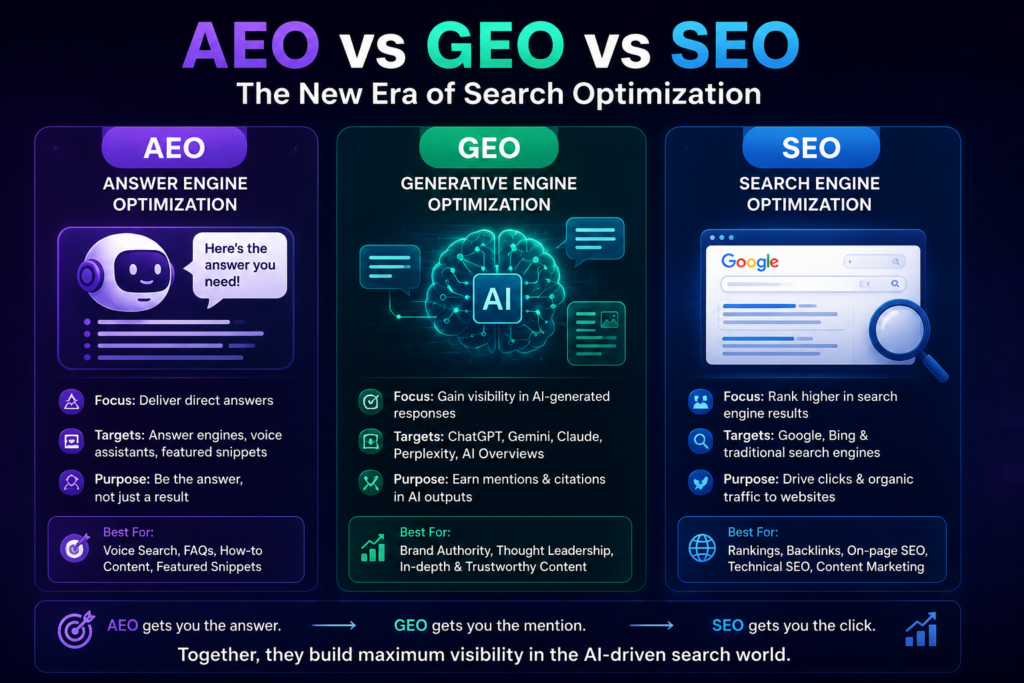
What is SEO in AEO vs GEO vs SEO?
SEO (Search Engine Optimization) is the traditional process of improving a website’s visibility on search engines like Google and Bing.
The main purpose of SEO is to rank higher in search engine results pages so users can discover your business when searching online.
SEO mainly includes:
- Keyword Research
- On-Page SEO
- Technical SEO
- Link Building
- Content Marketing
- Mobile Optimization
- Website Speed Improvement
For example, when someone searches:
“Best Digital Marketing Company”
Google displays websites based on hundreds of ranking factors.
The higher your website ranks, the more traffic and leads you can generate.
SEO has been one of the most important digital marketing strategies for years. However, search behavior is now changing because users increasingly depend on AI-generated answers.
What is AEO (Answer Engine Optimization)?
AEO stands for Answer Engine Optimization.
It is the process of optimizing content so AI assistants and search engines can provide your information as a direct answer to user queries.
Unlike traditional SEO, AEO focuses more on:
- Direct Answers
- Conversational Queries
- Voice Search
- Featured Snippets
- FAQ Optimization
- Structured Content
Modern users often ask complete questions such as:
- “Which is the best SEO agency in Jaipur?”
- “How does digital marketing help businesses grow?”
- “What is the difference between SEO and GEO?”
AI platforms analyze websites and choose the most helpful answers.
If your content is properly optimized, AI systems may directly recommend your business or display your information in answer boxes.
This improves:
- Brand Visibility
- User Trust
- AI Recognition
- Organic Reach
AEO is becoming essential because users now prefer fast and accurate responses instead of clicking through multiple websites.
What is GEO (Generative Engine Optimization)?
GEO stands for Generative Engine Optimization.
It focuses on optimizing websites and content for AI-generated search experiences.
GEO helps businesses appear inside AI-generated responses on platforms such as:
- ChatGPT
- Google AI Overviews
- Gemini
- Claude
- Perplexity
- AI Search Assistants
Traditional SEO focuses mainly on search rankings.
GEO focuses on something much bigger:
- AI Mentions
- AI Citations
- Brand Authority
- Content Trustworthiness
- Contextual Relevance
AI search engines do not simply rank websites based on keywords.
They evaluate:
- Expertise
- Brand Reputation
- User Experience
- Online Mentions
- Content Quality
- Structured Information
- Trust Signals
If AI systems trust your content, they are more likely to mention your business in generated answers.
That visibility can significantly improve brand awareness and customer trust.
AEO vs GEO vs SEO: Understanding the Difference
| Feature | SEO | AEO | GEO |
|---|---|---|---|
| Main Goal | Website Rankings | Direct Answers | AI Visibility |
| Focus Area | Search Engines | Answer Engines | AI Platforms |
| User Action | Click Website | Read Quick Answers | Trust AI Responses |
| Content Style | Keyword-Based | Conversational | Contextual & Authoritative |
| Important Platforms | Google & Bing | Voice Search & AI Assistants | ChatGPT, Gemini, AI Overviews |
| Success Metric | Organic Traffic | Featured Snippets | AI Mentions & Citations |
Why AEO and GEO Are Important in 2026
Search behavior has evolved rapidly over the last few years.
Today’s users expect:
- Faster Answers
- Personalized Results
- Conversational Search
- Voice-Based Interaction
- AI Recommendations
Because of this shift, traditional SEO alone is no longer enough.
Many users now receive their answers directly from AI systems without even visiting websites.
This trend is known as “zero-click search.”
If your business is not optimized for AI search, you may lose:
- Organic Visibility
- Website Traffic
- Potential Leads
- Brand Awareness
- Competitive Positioning
Businesses that adapt early to AEO and GEO will be better positioned for future digital success.
Benefits of AEO vs GEO vs SEO for Businesses
1. Increased Brand Visibility
AI platforms can directly recommend your business to users.
This allows your brand to appear in:
- AI-generated answers
- Featured snippets
- Voice search results
- Smart assistant recommendations
The more frequently your brand appears, the stronger your online presence becomes.
2. Better Quality Leads
Users interacting with AI search often have stronger purchase intent.
This means businesses can receive:
- More Relevant Leads
- Higher Conversion Rates
- Improved Customer Engagement
AI-driven users usually search with specific questions and are closer to making decisions.
3. Stronger Brand Trust
When AI systems repeatedly recommend your business, users naturally begin to trust your brand.
AI recommendations work like digital authority signals.
Businesses with:
- Strong content
- Positive reviews
- Clear expertise
- Helpful information
are more likely to earn AI trust.
4. Long-Term Business Growth
SEO rankings can fluctuate because of algorithm updates.
However, strong AI authority creates long-term visibility.
Businesses investing in GEO and AEO today are building sustainable digital growth for the future.
5. Competitive Advantage
Most businesses are still focused only on traditional SEO.
Companies adopting AI optimization strategies early can:
- Build authority faster
- Dominate AI search results
- Reach new audiences
- Stay ahead of competitors
This creates a major advantage in the digital marketplace.
How AEO vs GEO vs SEO Drive Business Growth
Improved Online Presence
Your business can become visible across multiple platforms including:
- Google Search
- AI Overviews
- ChatGPT
- Voice Search
- Smart Assistants
This expands your overall digital reach.
Higher Customer Trust
When AI tools mention or recommend your business directly, users often trust the recommendation more than traditional advertisements.
This improves brand credibility and customer confidence.
Better User Experience
AI-focused content is usually:
- Clear
- Structured
- Helpful
- Easy to Understand
This improves user engagement and satisfaction.
Higher Conversion Opportunities
Users who arrive through AI recommendations are often highly targeted.
This can increase:
- Sales Opportunities
- Business Inquiries
- Conversion Rates
- Customer Retention
Best AEO vs GEO vs SEO Strategy for 2026
The future of search is no longer limited to traditional SEO.
The smartest businesses in 2026 are combining:
- SEO for Search Rankings
- AEO for Direct Answers
- GEO for AI Visibility
This combined strategy creates:
- Better Online Visibility
- Stronger Brand Authority
- Higher Organic Reach
- Sustainable Growth
- Better Lead Generation
Businesses that adapt to AI search today will be far more prepared for the future.
Final Thoughts on AEO vs GEO vs SEO
Artificial intelligence is reshaping the future of digital marketing and online search.
While SEO remains important, businesses now need to focus equally on AEO and GEO to stay visible in AI-powered search environments.
Modern users want instant answers, personalized recommendations, and conversational search experiences.
Businesses that optimize for AI search can:
- Increase Brand Visibility
- Build Customer Trust
- Generate Better Leads
- Improve Online Authority
- Achieve Long-Term Growth
In 2026, the brands that succeed online will not only rank on Google but will also appear inside AI-generated answers.
The future belongs to businesses that are ready for AI-driven search optimization.