
ChatGPT vs Claude for SEO: Which AI Should You Actually Use?
Every SEO professional in 2026 has an AI tool open in at least one tab. The question is — are you using the right one? ChatGPT and Claude are both brilliant, but they’re built differently, they think differently, and they perform very differently when it comes to SEO work.
Let’s break it down — no fluff, no unnecessary hype.
First, Let’s Agree on What “Good for SEO” Actually Means
Before we compare, let’s get on the same page.
When we say an AI tool is good for SEO, we mean it helps you do things like:
Research keywords with depth, not just surface-level suggestions
Write content that reads as a human wrote it (because Google can tell)
Understand search intent and structure content around it
Produce meta tags, title tags, and descriptions that aren’t boring
Audit and improve existing content with real suggestions
Now, with that lens on — let’s look at both tools honestly.
ChatGPT: The Workhorse Everyone Knows
ChatGPT, built by OpenAI, needs no introduction. Most SEO teams adopted it first, simply because it arrived first. And it’s genuinely good at a lot of things.
Where ChatGPT shines in SEO:
Bulk content generation. Need 50 product descriptions? ChatGPT handles volume well.
Integrations. With GPT-4o and the growing plugin ecosystem, ChatGPT can connect directly with tools like Surfer SEO and Ahrefs.
Speed. It’s fast, and with the right prompts, it gets to the point quickly.
Image generation. DALL·E integration means you can create visuals for your blog in the same window — something Claude doesn’t offer natively.
But here’s where things get complicated.
ChatGPT has a tendency to “hallucinate” with more confidence than it should. For SEO purposes — especially when you’re pulling data about search trends, competitor backlinks, or ranking factors — overconfident wrong answers are a problem.
Also: the writing, while fast, can feel templated. A lot of ChatGPT-generated content sounds like ChatGPT-generated content. And Google is getting smarter about that every single quarter.
Claude: The Thoughtful Challenger
Claude, built by Anthropic, came into the spotlight more quietly -but it’s been winning over writers, strategists, and SEOs who actually read its output.
Where Claude wins in SEO:
Long-form content quality. Claude writes longer, more nuanced pieces without losing their thread. For pillar pages, in-depth guides, or thought leadership articles, it’s noticeably better.
Tone consistency. Tell Claude to write like a senior strategist at a digital agency in Jaipur, and it actually maintains that voice throughout – not just for the first paragraph.
Less “AI smell.” Claude’s output tends to be more varied, more natural, and less repetitive in sentence structure. That matters for both readers and ranking algorithms.
Following complex instructions. Claude is exceptional at multi-layered prompts. If you say “write a blog structured like X, in tone Y, targeting keyword Z, for audience W” – it listens to all of it.
Where Claude falls short:
No real-time browsing by default (though Claude.ai now has web search).
No native image generation.
Not as widely integrated with third-party SEO tools yet.
ChatGPT
- Fast bulk content
- Strong plugin ecosystem
- Built-in image generation
- Voice/multimodal features
- Can feel templated in tone
Claude
- Superior long-form writing
- Natural, non-AI tone
- Better instruction-following
- More nuanced reasoning
- Fewer hallucinations on content tasks
The real SEO edge in 2026 isn't just using AI — it's knowing whether to open ChatGPT or Claude.
Let’s Talk About Specific SEO Tasks
Keyword Research
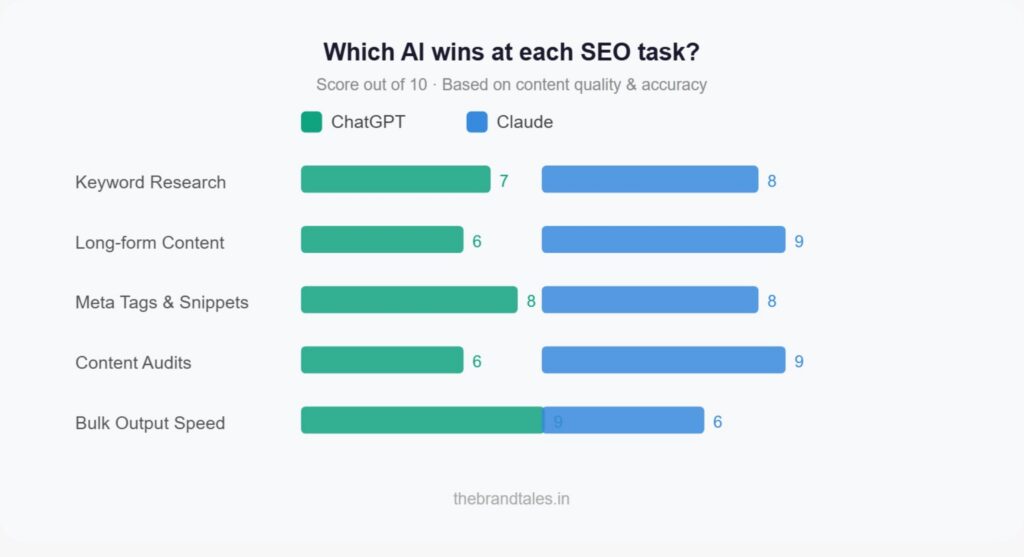
Neither tool replaces actual keyword tools like Semrush or Ahrefs. But for brainstorming keyword clusters, understanding user intent, or building topical maps, Claude is more thorough. It asks itself, “What else would someone searching this topic care about?” ChatGPT gives you a list. Claude gives you a framework.
On-Page Content Writing
Claude wins here. Consistently. The writing feels more like a person sat down and thought it through rather than a machine outputting tokens at speed. For any content you’re putting on a client-facing or authority page, Claude is the safer bet.
Meta Tags and Snippets
Honestly? Both tools do this well. Neither has a major edge on short-form, structured output like meta titles and descriptions. Use whichever you’re already working in.
Content Audits and Rewrites
Claude is significantly better at reading existing content, identifying its weaknesses, and making targeted improvements. Paste a low-ranking blog post into a low-ranking blog post and ask Claude why it might not be ranking — the analysis tends to be sharper and more actionable.
Technical SEO Explanations
If you need to explain crawl budget, structured data, or canonical tags to a client in plain English, Claude writes clearer, more accurate explanations. Less jargon, more clarity.
Bottom Line
If you need volume, speed, and tool integrations, ChatGPT is still a strong choice. If you need quality, consistency, and content that doesn’t read like everyone else’s AI output, Claude is the better SEO tool for 2026.
The Honest Answer: Use Both
Here’s what the smartest SEO teams are actually doing right now:
1
Use ChatGPT for quick ideation, FAQs, product descriptions, and tasks that need speed over depth.
2
Use Claude for long-form articles, brand voice content, content strategy documents, and anything that needs to sound genuinely human.
3
Layer both with real SEO tools — keyword data, backlink analysis, and SERP tracking still need dedicated platforms.
4
Edit every AI draft. Neither tool replaces human expertise, knowledge of your audience, or awareness of your competitors. Always add your perspective and final judgment.
What This Means for Brands in India
If you’re running a business in Jaipur, Delhi, or anywhere in India and trying to compete on Google, AI-generated content is a tool, not a strategy.
The brands that are winning SEO right now are the ones using AI to move faster, but pairing it with genuine expertise — knowing which keywords actually convert, understanding local search behavior, and building content that serves real intent.
In short, the future of SEO in 2026 will depend on how well you combine AI efficiency with human expertise. Use the strengths of both ChatGPT and Claude, but never lose sight of your unique brand voice, your market, and your audience’s real needs. Success comes from integration, not substitution—AI is your tool, not your strategy. Choose wisely, edit thoughtfully, and stay ahead.